Value Shopping in Japan: Price Hikes, Point Programs & Savings Habits
Key Points
- Price pressure is still high: food makers raised prices on 3,153 items in October 2026, and 54.4% of adults in the BOJ's September survey said life has less slack than a year ago.
- Saving has split and become routine: in receipt data from 143,869 users, private-label switching and markdown hunting did not grow, while habits set once, such as buying at one supermarket, did.
- Creator briefs should place the product inside the shopper's store and points routine (which store, which points, cost per use) rather than relying on one-off coupons.
Price rises in Japan peaked again in autumn 2026 and most households still feel squeezed and expect further increases
Teikoku Databank counted 3,153 food and beverage price increases from 195 major makers in October 2026¹.
September, at 4,965 items, was the highest month of the year, and known increases for 2026 total 20,187, the second year in a row above 20,000.
Alcohol and soft drinks led October with 1,399 items.
TDB expects the rush to ease after October, but it also expects intermittent increases to continue into 2027¹.
Households still feel it.
In the Bank of Japan's opinion survey, carried out from August to early September with 1,972 valid responses, 54.4% said their living conditions had less slack than a year earlier and 4.5% said they had more².
Asked about the next 12 months, 38.8% planned to cut spending and 10.5% to raise it.
The Cabinet Office's consumer survey points the same way: 90.6% of households of two or more people expected the prices of goods they buy often to be higher in a year's time in September, and 90.8% in October³.
For an overseas brand selling into Japan, the useful question is how these households save.
Receipt data gives an answer that most outsiders would not expect.
Japanese shoppers now save through fixed store and points routines instead of switching products item by item
Reschalle, a saving app run by Kurashiru where users upload receipts, compared the same 143,869 users in summer 2025 and summer 2026, across more than 51 million receipts⁴.
The largest group, 27.2%, eased off saving, and almost as many, 26.6%, saved harder.
These are users of a saving app, so the finding is the split itself: even among saving-minded shoppers, the response to prices is no longer uniform.
The methods changed as well.
Private-label purchases and markdown use did not increase overall, and neither did visiting several stores.
Behaviour that is decided once and then repeated did grow: buying at a supermarket rather than a convenience store, drinking less and eating out less⁴.
Naoko Kuga of NLI Research Institute, who supervised the analysis, reads it as shoppers settling which store to use and which points to collect, so they no longer weigh every purchase⁴.
Points programmes are part of that fixed setup.
In MMD Labo's July 2026 survey of 25,000 people aged 18 to 79, 62.6% said they are conscious of a points economic zone⁵.
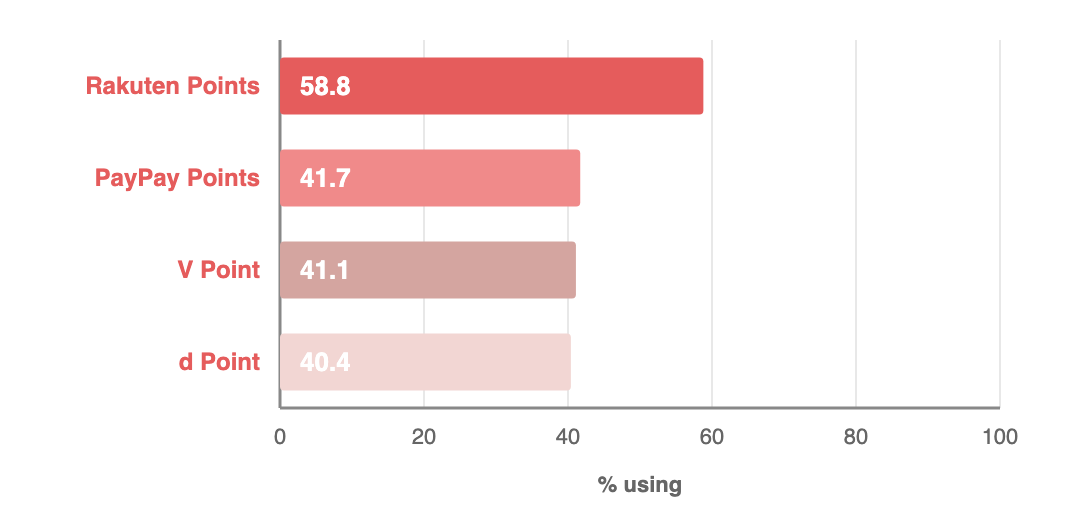
Rakuten Points were in active use by 58.8%, followed by PayPay Points (41.7%), V Point (41.1%), d Point (40.4%) and Ponta (38.4%) (Chart 1).
Among people whose main zone is Rakuten, the most common way in was the Rakuten marketplace, cited by 31.0%⁵.
A brand that relies on shoppers comparing products one by one is asking for the effort these shoppers have stopped making.
Brands should use creators to place products inside shoppers' existing store and points routines rather than run one-off discount pushes
Kuga's own conclusion is that companies need to offer some value but also cut the effort of choosing, travelling and keeping track, and fit into the shopping places and routes consumers have already settled on⁴.
For creator programmes, that suggests three changes.
First, the brand and its local agency should favour mid-tier saving and poi-katsu (points-collecting) creators, and brief them to name the exact chain or marketplace where the product is sold and which points programme applies.
A post that only says "available at major retailers" leaves the shopper to do the work the receipt data says they now avoid.
Second, the e-commerce lead should time creator posts to the points events of the zone where the product actually sells.
For a brand that sells mainly on Rakuten, that means Rakuten's campaign calendar, and the post should show both the price and the points earned⁵.
Third, food, drink and household brands should have creators show cost per use and repeat-use scenes rather than push a new coupon code each month.
TDB expects price increases to continue into 2027¹, and a product that fits a weekly routine is likely to keep its place longer than one bought once on a discount.
References
- 帝国データバンク, 2026 · https://www.tdb.co.jp/report/economic/20260930-pricepass-on202609/
- 日本銀行(生活意識に関するアンケート調査 第107回), 2026 · https://www.boj.or.jp/research/o_survey/data/ishiki2610.pdf
- 内閣府 経済社会総合研究所(消費動向調査), 2026 · https://www.esri.cao.go.jp/jp/stat/shouhi/gaiyou.pdf
- クラシル(レシチャレ), 2026 · https://prtimes.jp/main/html/rd/p/000000481.000019382.html
- MMD研究所, 2026 · https://mmdlabo.jp/investigation/detail_2566.html
About MegaEvolution
MegaEvolution is a global influencer marketing agency and platform that connects brands with creators across borders. With local representation in core markets — including Japan, Korea, the United States, Vietnam, Thailand, the Philippines, Indonesia, China, Russia, and more — and services spanning numerous additional markets, we ensure seamless communication and collaboration between brands and creators worldwide.
Global reach. Local expertise. Let MegaEvolution elevate your brand worldwide.
Contact Us
- Official Website: https://www.megaevolution.io
- Contact Form: info@megaevolution.io
- Official Social Media: Instagram / LinkedIn


