Silver Shoppers in China: 618 Growth, Health Claims & Creator Vetting
Key Points
- Older users were the only group whose attention to 618 content rose in 2026, from 19.5% to 25.2%
- SAMR is fining livestream health claims aimed at older buyers, on Douyin and on sellers' own apps
- Brands need to vet creators and scripts for health claims before targeting older audiences
China's online audience is ageing fast
At the end of 2025 China had 323.38 million people aged 60 and over, 23.0% of the population.
Those aged 65 and over were 15.9%¹.
Just over half of the 60-plus group is online: CNNIC put internet use in that age band at 53.7% in December 2025².
Mobile data shows the same shift from another angle.
QuestMobile counted 1.282 billion monthly active mobile users in June 2026.
Users over 45 made up 39.5% of them, 2.4 points more than a year earlier, and users in third- and fourth-tier cities 41.5%, up 0.7 points³.
The two sources measure different groups, over-60s in one and over-45s in the other, so they cannot be added together.
They do point the same way.
Older users are a large part of China's online market, and the share still has room to grow, since almost half of people over 60 are not yet online.
Older users are now where 618 growth comes from
QuestMobile's report on the 2026 618 festival calls silver users the festival's core incremental group.
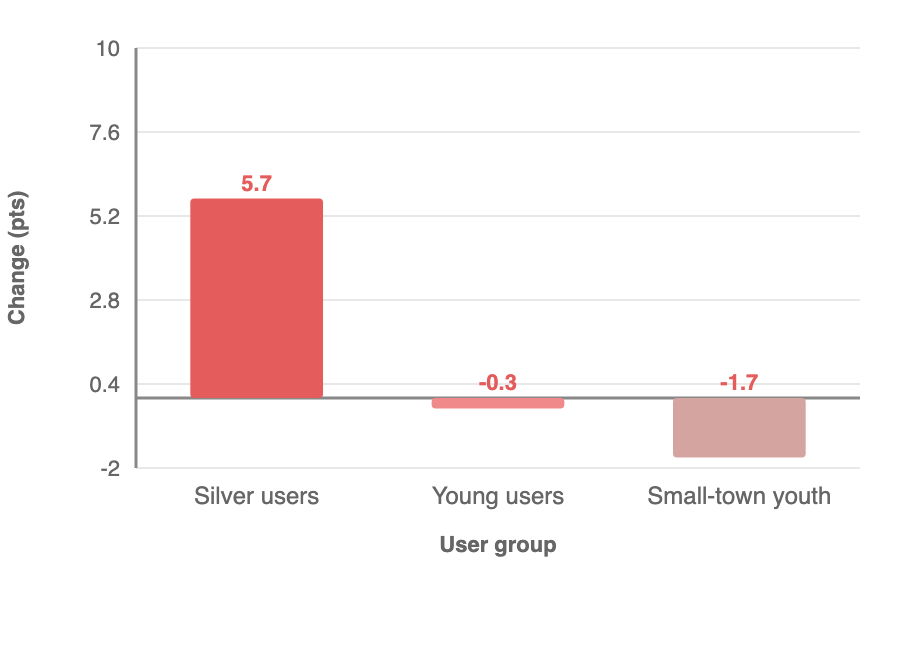
Their attention to 618 content rose from 19.5% in 2025 to 25.2% in 2026.
Over the same period it fell among small-town young users, from 39.5% to 37.8%, and among the broader young segment, from 29.5% to 29.2%⁴ (Chart 1).
The measure is attention to festival content, not spending, and the report does not give silver users' share of 618 sales.
It is still the only group in that comparison that grew.
Mobile shopping already reaches 87.8% of users, so platforms are competing for existing users rather than new ones, and new attention is coming from older users⁴.
The platforms have noticed.
QuestMobile names silver users, along with young users, as the core groups that comprehensive e-commerce platforms brought in during the first 618 sales wave, and notes that Kuaishou did especially well with older users in lower-tier markets⁴.
A 618 plan built only around young urban audiences misses the one segment whose interest is rising.
Livestream health claims aimed at seniors are an enforcement priority
On 2 September 2026 the State Administration for Market Regulation (SAMR) published nine cases of unfair competition in services for older people.
A Suzhou media company was fined 350,000 yuan over Douyin livestreams that used invented ancestral-remedy stories to sell ordinary food as a cure.
A Hunan company was fined 400,000 yuan for claiming, through its own app, that selenium tablets could suppress tumour cells⁵.
The cases follow a national campaign.
In 2025 SAMR's campaign against false advertising of medicines and health products to older people handled 6,175 cases, collected 103.5 million yuan in fines and confiscations, and ordered 4,908 businesses to make corrections⁶.
SAMR singled out private livestream rooms.
Sellers drew older consumers in with free health talks and livestream giveaways, then moved them into closed rooms where false claims were harder to see.
Regulators went after the platforms that host those rooms as well as the sellers⁶.
For a brand, a health claim a creator makes about its product during a livestream is still a claim about that product.
Target silver buyers through vetted creators and checked scripts
For foreign health, food and personal-care brands, older Chinese buyers are a growing audience, and the creator formats that reach them are watched most closely.
Three steps follow from the cases above.
First, check each creator's past content before signing.
Earlier videos that sold ordinary food or supplements as treatment are the clearest warning sign⁵.
Second, keep selling on public platforms such as Douyin, Kuaishou and Tmall, where content can be reviewed afterwards.
Private livestream rooms that viewers reach through group chats are where SAMR found the problem spreading⁶.
The Douyin case shows that selling on a public platform does not prevent enforcement, but it does leave a record of what was said.
Third, write the claims into the script.
Every statement about what the product does should match its registered functions, and ordinary food should carry no health claim at all.
Hosts also need a set answer for viewers who ask whether the product treats a condition, because that question comes up live.
References
- 国家统计局, 2026 · https://www.stats.gov.cn/sj/zxfb/202602/t20260228_1962662.html
- 中国互联网络信息中心(CNNIC), 2026 · https://cnnic.cn/n4/2026/0304/c88-11549.html
- QuestMobile, 2026 · https://www.questmobile.cn/research/report/2084487578531254273/
- QuestMobile, 2026 · https://www.questmobile.cn/research/report/2070037399023398914/
- 国家市场监督管理总局(中新网), 2026 · https://www.chinanews.com.cn/cj/2026/09-02/10688717.shtml
- 国家市场监督管理总局(京报网), 2026 · https://news.bjd.com.cn/2026/01/27/11549337.shtml
About MegaEvolution
MegaEvolution is a global influencer marketing agency and platform that connects brands with creators across borders. With local representation in core markets — including Japan, Korea, the United States, Vietnam, Thailand, the Philippines, Indonesia, China, Russia, and more — and services spanning numerous additional markets, we ensure seamless communication and collaboration between brands and creators worldwide.
Global reach. Local expertise. Let MegaEvolution elevate your brand worldwide.
Contact Us
- Official Website: https://www.megaevolution.io
- Contact Form: info@megaevolution.io
- Official Social Media: Instagram / LinkedIn


