Inbound Tourism in Japan: SNS Trip Planning, US Visitors & Tax Refunds
Key Points
- Social platforms (43.3%) and video sites (39.6%) were the most useful pre-trip sources for visitors to Japan in 2025; the official JNTO website was cited by 12.2%
- The US became the largest inbound spending market in April to June 2026, while Chinese spending fell by almost half
- From 1 November 2026, tax-free shoppers pay tax at the till and get it back only after customs checks the goods at departure
Visitors to Japan rely on social platforms and video sites far more than on official tourism channels when planning
The Japan Tourism Agency's 2025 annual survey of visitor spending asked which sources had been useful before the trip.
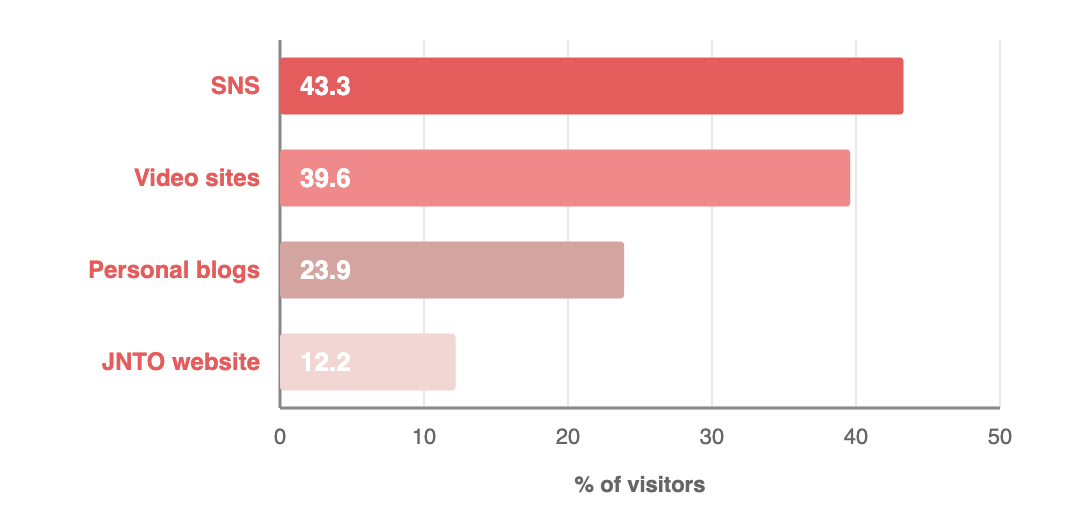
SNS came first at 43.3%, video sites second at 39.6% and personal blogs third at 23.9%.
The official JNTO website was chosen by 12.2%, and JNTO's tourist information centres by 1.6%¹ (Chart 1).
The two leading answers are channels, not authors.
A post on social media can come from a creator, a friend or a hotel, and the survey does not separate them.
Friends and relatives at home are also listed as an answer of their own.
So the figures cannot say how much of the 43.3% is creator content.
What they do show is where the shortlist gets made: in social feeds and on video platforms, weeks before the visitor lands.
A shop, a product or a region that does not appear there is unlikely to be on the list at all.
A page on the JNTO website reaches roughly one visitor in eight.
The markets sending visitors have shifted within a year, toward the US, Korea, Taiwan and Hong Kong
Visitors spent ¥2.5096 trillion in April to June 2026, 0.2% more than a year earlier.
The total barely moved; its make-up did.
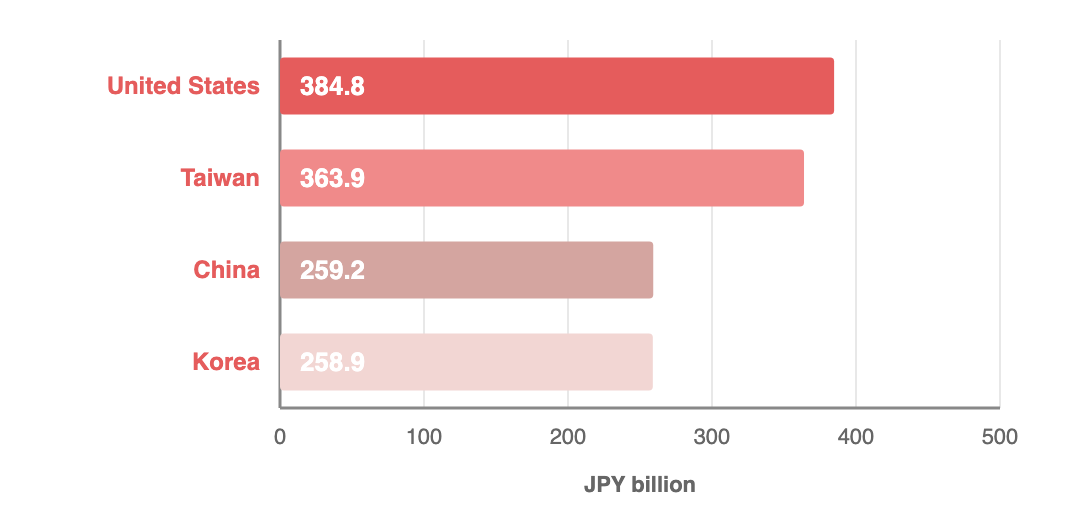
The United States was the largest market at ¥384.8 billion, followed by Taiwan at ¥363.9 billion.
China, the largest market a year earlier at ¥506.4 billion, fell to ¥259.2 billion, a drop of 48.8%² (Chart 2).
Arrivals point the same way.
JNTO estimates 3,098,900 visitors in August 2026, 9.6% fewer than in August 2025, yet 14 markets set August records, among them Korea, Taiwan, Hong Kong and the US³.
The markets that are growing also travel differently.
In a July 2025 survey by the Development Bank of Japan and the Japan Travel and Tourism Foundation, around 90% of Hong Kong respondents who had been to Japan were repeat visitors, as were around 80% of those from Taiwan and Korea.
Among Chinese respondents, drawn from Beijing and Shanghai only, first-time visitors were more than half.
Interest in regional destinations rose with the number of past trips⁴.
Creator content built for a first trip to Tokyo and Kyoto was written for the group that is now spending less.
Tax-free shopping changes on 1 November 2026, and visitors will need to know the new steps
From 1 November 2026, Japan's tax-free system moves to a refund model.
Visitors pay the tax-inclusive price at the till.
The shop returns the consumption tax only after customs confirms, at the airport or seaport, that the goods are leaving Japan⁵.
Two conditions will catch shoppers out.
The goods have to be carried out and shown to customs; sending them home separately does not qualify.
And if one item on a purchase record fails the customs check, the whole record loses its tax-free status⁵.
The refund itself is paid by the shop or by a refund service the shop has contracted.
For most visitors the first sign of the change will be a higher total at the register.
A repeat visitor from Taiwan or Korea who has shopped tax-free for years may assume the old rules still apply, and that is where questions and abandoned purchases are likely to come from.
Creators who already cover shopping in Japan for these audiences are a practical way to explain the steps before people travel.
A short video that shows the till, the customs desk and the refund arriving answers the question earlier than a notice at the counter can.
Brands selling to visitors should rebalance creator spend by source market and update content before November
Inbound creator budgets were often planned around China, the market that led spending until 2025.
The April to June 2026 figures point elsewhere.
It is worth moving part of that budget to creators followed in Taiwan, Korea, Hong Kong and the US, the markets that grew²,³.
The brief should change with the audience.
Most visitors from those markets have been to Japan before, and another Tokyo shopping haul tells them little.
Content on regional towns, seasonal events and specific shops is more likely to reach them⁴.
The tax change sets a deadline.
Posts that explain the refund-at-departure steps need to be live before 1 November, ahead of bookings for the year-end season⁵.
Brands with stores in airports or shopping districts can give creators their own till and refund counter to film.
A practical first step is to list current creator partners by audience country and set that list against the April to June spending table.
References
- 観光庁, 2026 · https://www.mlit.go.jp/kankocho/content/002003329.pdf
- 観光庁, 2026 · https://www.mlit.go.jp/kankocho/content/002011742.pdf
- 日本政府観光局(JNTO), 2026 · https://www.jnto.go.jp/news/press/20260916_montly.html
- 日本政策投資銀行・日本交通公社, 2026 · https://www.dbj.jp/investigate/assets/202606121330.pdf
- 観光庁, 2026 · https://www.mlit.go.jp/kankocho/tax-free/page01_000001_00019.html
About MegaEvolution
MegaEvolution is a global influencer marketing agency and platform that connects brands with creators across borders. With local representation in core markets — including Japan, Korea, the United States, Vietnam, Thailand, the Philippines, Indonesia, China, Russia, and more — and services spanning numerous additional markets, we ensure seamless communication and collaboration between brands and creators worldwide.
Global reach. Local expertise. Let MegaEvolution elevate your brand worldwide.
Contact Us
- Official Website: https://www.megaevolution.io
- Contact Form: info@megaevolution.io
- Official Social Media: Instagram / LinkedIn


