Health Supplements in Korea: MFDS Ad Rules, Expert Endorsements & YouTube
Key Points
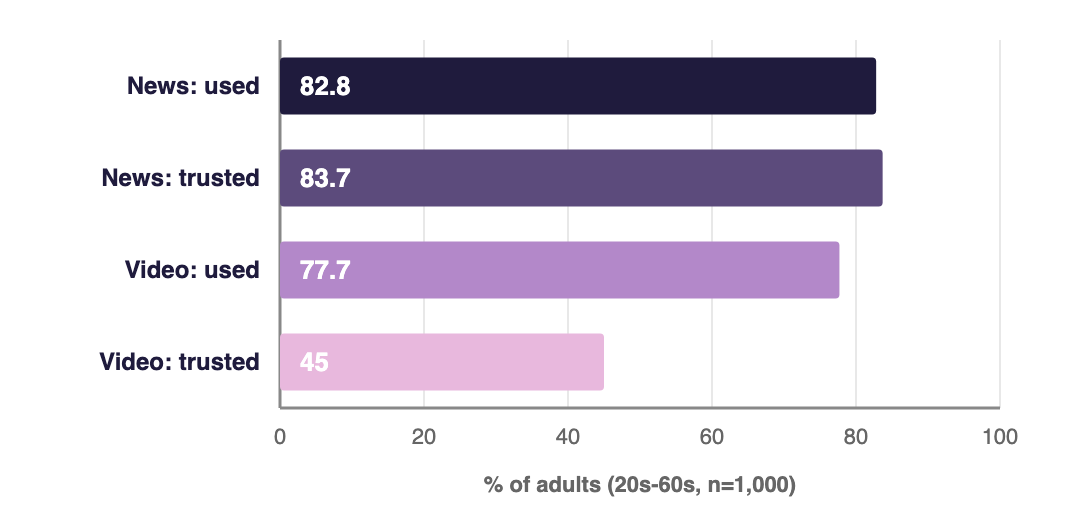
- 90.8% of Korean adults surveyed have seen health content on YouTube, yet 45.0% trust video platforms for health information, against 83.7% for news articles
- MFDS caught 26 diet-food sellers in July 2026 over celebrity, pharmacist and AI-made video ads; from Nov 27, 2026, expert endorsements, real or AI-generated, can bring a business suspension
- Health functional food ads must pass pre-review, so brands should screen every script before filming, drop expert-style endorsements and check creators' past diet posts
Koreans learn about supplements on YouTube but trust it less than news
Korea's health functional food market, the certified supplement category, reached KRW 5.96 trillion in 2025, up 0.2% on the year, according to a Korea Health Functional Food Association survey of 6,700 households¹.
Online channels took 71.0% of those sales¹.
With the total barely growing, a new brand mostly has to win buyers from existing ones, and most of that contest takes place online.
Buyers meet health claims on video before they reach a store page.
In an April 2026 online survey of 1,000 adults in their 20s to 60s, the Korea Press Foundation found that 90.8% had seen health or medical content on YouTube².
Video platform content was trusted as a health source by 45.0% of respondents, eighth of the sources tested, against 83.7% for news articles². (Chart 1)
Most respondents (85.8%) also said they had come across health information they felt was inaccurate or exaggerated².
A supplement brand working with Korean creators is therefore reaching people who have nearly all watched health videos and largely discount them.
Sellers that answered that doubt with bigger promises are the ones MFDS has been catching.
MFDS is now policing the creator side of diet product sales
On July 23, 2026, the Ministry of Food and Drug Safety (MFDS) said it had caught 26 companies advertising diet foods illegally, asked local governments to impose penalties and filed criminal complaints³.
The products ranged from olive oil sold on the 'OleShot' trend with anti-aging and detox claims to foods described as 'oral Wegovy' or GLP-1 products³.
The 26 companies sold about 600,000 units, worth roughly KRW 11.5 billion⁴.
In the ads, celebrities or pharmacists recommended the product, or AI-generated people and images of body fat were used to claim appetite suppression and fat blocking³.
The short videos ran repeatedly on Facebook, Instagram and YouTube and linked to the seller's own store.
Some sellers kept the strongest claims in the video and softened the store page, which MFDS inspects more regularly³.
The case followed a 2025 precedent.
In August that year, MFDS referred five firms to prosecutors for handing creators keywords such as 'lose 7kg in a month' and 'powerful appetite suppression' to post on blogs and social accounts as personal reviews.
The five sold KRW 32.4 billion from January 2024 to June 2025⁵.
In both cases MFDS pursued the companies that wrote or paid for the claims, not only the accounts that posted them.
A creator review built from a brand's own keyword list is likely to be read as that brand's ad.
Expert endorsements, real or AI-made, will carry business suspension from November 27
The legal basis is an amendment to the Food Labeling and Advertising Act, promulgated on May 26, 2026 as Act No. 21707⁶.
MFDS has published a draft amendment to the Act's enforcement rule, set to apply from November 27, 2026.
Under it, an ad that uses AI-generated images, video or voice to suggest that a doctor, dentist, Korean medicine doctor, veterinarian, pharmacist or university professor is endorsing a food becomes grounds for business suspension.
For a food manufacturer, the proposed penalty is 15 days for a first violation, one month for a second and two months for a third⁶.
The draft also raises the penalty for real experts.
When an actual doctor, pharmacist or professor vouches for a product's function, or is shown recommending or using it, the penalty is brought up to the same level as in the AI case⁶.
Two formats common in supplement campaigns fall inside this.
One is the creator who is also a licensed professional, such as a pharmacist who reviews products.
The other is an AI avatar dressed as a doctor.
The July case already featured both pharmacists and AI-generated people³.
A business suspension halts the company's operations while it lasts, so the more realistic reading for a brand is that an expert-style endorsement puts its whole Korean sales channel at risk, not one post.
Keep creators, but build claim screening into every brief
Video is still where 90.8% of Korean adults have met health content², so a supplement brand still needs creators.
Three changes to the brief would cover most of the exposure seen in the two MFDS cases.
First, screen every script, caption and on-screen line against the Food Labeling and Advertising Act before filming, including short-form cut-downs.
MFDS now reads the video itself, not only the store page³.
Health functional food ads must also pass a pre-review, and some of the products caught in July had skipped that review or ignored its result³.
The legal check is worth starting from the reviewed copy rather than the creator's draft.
Second, drop expert-style endorsements.
From November 27, 2026, a doctor, pharmacist or professor recommending a food, real or AI-generated, can lead to a business suspension⁶.
Everyday users describing how they use a product are the safer format, as long as they make no weight-loss or treatment claims.
Third, check each creator's past diet and health posts before contracting.
In the 2025 case MFDS acted on creator reviews written from the sellers' keywords⁵, so an account with a history of 'lose 7kg'-style posts is a likely place for the next inquiry to start.
For a campaign planned for late 2026 or 2027, a practical first step is to pull every Korean script that mentions weight, GLP-1 or a professional title and re-review it before November 27.
References
- 데일리팜(한국건강기능식품협회 조사), 2025 · https://dailypharm.com/user/news/128
- 한국언론진흥재단 미디어 서베이, 2026 · https://www.kpf.or.kr/front/board/boardContentsView.do?board_id=246&contents_id=b2d758ce687f4462b06f90d499ada0d7
- 식품의약품안전처 보도자료, 2026 · https://mfds.go.kr/brd/m_99/view.do?seq=50220
- 뉴시스, 2026 · https://www.newsis.com/view/NISX20260723_0003720580
- 데일리팜, 2025 · https://m.dailypharm.com/user/news/2974
- 데일리팜, 2026 · https://www.dailypharm.com/user/news/341236
About MegaEvolution
MegaEvolution is a global influencer marketing agency and platform that connects brands with creators across borders. With local representation in core markets — including Japan, Korea, the United States, Vietnam, Thailand, the Philippines, Indonesia, China, Russia, and more — and services spanning numerous additional markets, we ensure seamless communication and collaboration between brands and creators worldwide.
Global reach. Local expertise. Let MegaEvolution elevate your brand worldwide.
Contact Us
- Official Website: https://www.megaevolution.io
- Contact Form: info@megaevolution.io
- Official Social Media: Instagram / LinkedIn


