AI Ads in the Philippines: ASC Disclosure, Likeness Consent & Deepfakes
Key Points
- Since 21 September 2026, Philippine ads with AI-made or AI-enhanced content must carry a visible AI disclosure under ASC Circular 2026-014.
- Filipinos are the most familiar with generative AI in Southeast Asia, yet it scores lowest on trust of any technology category they rate (67.3 out of 100).
- Brands should audit creator assets for AI use, put the label on the asset, and get written consent for any AI likeness of a real person.
Filipino consumers know generative AI well but trust it less than any other technology they use
In the Southeast Asia Consumer Tech Trust Score 2026 by Vero and Kadence International, a survey of more than 3,000 consumers in six markets, the Philippines had the highest familiarity with generative AI at 50%¹.
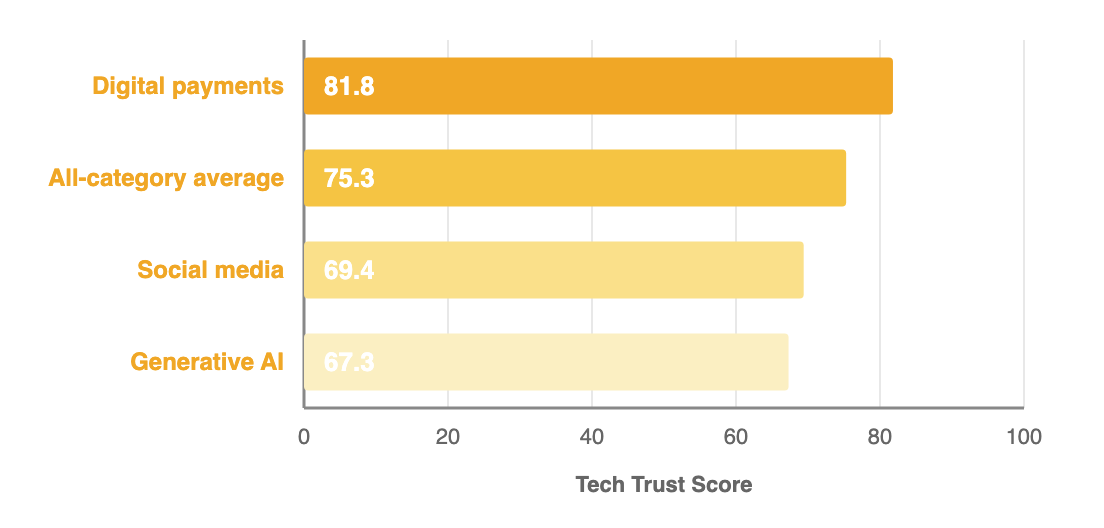
Its trust score for generative AI was 67.3 out of 100, the lowest of any technology category measured in the country, against 81.8 for digital payments¹ (Chart 1).
Social media, where most creator campaigns run, scored 69.4 even though 88% of Filipino respondents use it daily¹.
Inside companies, AI use is already high.
A Sprout Solutions survey of 3,516 Filipino employees in May 2026 found that 78% use AI in their daily work, and marketing is among the roles at 80-82%².
Only 35% had received training for AI in their role².
For brands, the risk is that agencies, in-house teams and creators are already producing with AI, often without training, for an audience that knows the technology well and trusts it less than anything else it uses.
The ASC now requires a visible AI disclosure on ads, effective 21 September 2026
The Ad Standards Council (ASC), the industry body that screens advertising in the Philippines, issued Circular 2026-014 on 18 September 2026, and it took effect three days later³.
It covers ads with content "created, generated, or materially enhanced" by AI, in whole or in part³.
Those ads must carry a disclosure such as "AI-generated", "AI-assisted", "Created with AI" or "Contains AI-generated content", shown in a way that is reasonably noticeable and legible for the format, with attention to font size and the background behind it³.
Three other provisions matter for creator work.
AI images, video, audio or voices that depict, closely resemble or could be mistaken for an identifiable real person have to comply with publicity and privacy rights, which can mean getting that person's consent³.
Rules on the use of minors still apply.
And advertisers remain fully responsible for every claim, depiction and endorsement in the ad, whether a person, an AI tool or both produced it³.
The ASC can issue a cease and desist order where it finds grounds³.
No government review sits on top of this.
In May 2026 the DTI said it was "not pursuing, implementing, or adopting" a draft order that would have required pre-clearance of ads, sponsored posts and digital campaigns, after business groups warned of delays of up to 30 working days⁴.
Senate bills would turn AI disclosure and likeness consent into legal duties
The ASC label is self-regulation, but two bills in the Senate would put similar duties into law.
Senate Bill 758, filed in August 2025 by Senator Bam Aquino, would require accounts to disclose AI-generated content clearly and fine those that do not; it would also require platforms to remove harmful material within 24 hours of a verified complaint⁵.
Senate Bill 1714, filed in January 2026 by Senator Robinhood Padilla, goes further on likeness and deepfakes: it would penalize using another person's identity in a fake ad to sell products or in fake videos that could mislead voters, with heavier maximum fines⁵.
Both were pending in the Senate Committee on Science and Technology as of May 2026⁵.
The government has set similar expectations for its own suppliers.
On 9 June 2026 the DICT and the Civil Service Commission issued Joint Memorandum Circular No. 003, s.
2026, an AI framework for public agencies that expects outside AI providers to meet the same standards⁶.
None of this is law for advertisers yet.
If either bill moves, though, it is likely that the ASC's wording on disclosure and likeness will be the reference point.
Creator contracts signed now, especially those that license a creator's digital twin or cloned voice, will be easier to keep compliant if they already cover consent and labeling.
Treat the AI label and likeness consent as production steps, not legal afterthoughts
Most of the work the circular creates happens in production, before an asset ever reaches the ASC.
Start with an audit.
List every creator and brand asset currently in production and mark where AI was used: generated footage, retouched faces, synthetic voiceover, AI dubbing.
Anything created or materially enhanced by AI needs the label³.
Then put the label on the asset itself.
The circular asks for a disclosure that is noticeable and legible against its background³, which a line in the caption may not meet once a video is reposted or cut down.
A burned-in "AI-generated" or "AI-assisted" tag stays with the file.
Finally, get written consent before any AI face or voice that resembles a real person goes live, including a creator's own digital twin used beyond the original campaign.
The advertiser is responsible for the result whoever built it³.
Filipino consumers also look for signs of compliance.
In the Vero and Kadence study, 23% of Filipino respondents named government approval and compliance as the strongest proof that a technology company can be trusted¹.
The ASC is an industry body, not a regulator, but a visible label that follows its rule is arguably the closest signal a creator ad can give.
References
- Vero & Kadence International (The Manila Times), 2026 · https://www.manilatimes.net/2026/08/30/business/sunday-business-it/ph-ranks-3rd-in-asean-tech-trust/2414479
- Sprout Solutions (Philstar), 2026 · https://www.philstar.com/headlines/2026/07/22/2543892/78-filipino-workers-use-ai-work-few-receive-training-study
- Ad Standards Council, 2026 · https://asc.com.ph/asc-circular-2026-014-guidlines-on-the-use-of-artificial-intelligence-in-advertising/
- The Freeman (Philstar), 2026 · https://www.philstar.com/the-freeman/cebu-business/2026/05/26/2530586/dti-drops-plan-pre-clearance-ads-after-business-backlash
- Foundation for Media Alternatives, 2026 · https://fma.ph/regulating-risk-the-20th-congress-of-the-philippines-response-to-artificial-intelligence/
- Baker McKenzie, 2026 · https://www.bakermckenzie.com/en/insight/publications/2026/07/philippines-launches-responsible-ai-governance-framework
About MegaEvolution
MegaEvolution is a global influencer marketing agency and platform that connects brands with creators across borders. With local representation in core markets — including Japan, Korea, the United States, Vietnam, Thailand, the Philippines, Indonesia, China, Russia, and more — and services spanning numerous additional markets, we ensure seamless communication and collaboration between brands and creators worldwide.
Global reach. Local expertise. Let MegaEvolution elevate your brand worldwide.
Contact Us
- Official Website: https://www.megaevolution.io
- Contact Form: info@megaevolution.io
- Official Social Media: Instagram / LinkedIn


